

About Markets
ASEAN Real Estate Markets: Opportunities, Trends & Outlook
Exploring Real Estate and Hospitality Investment Opportunities Across Southeast Asia
Marcus Sandberg
August 28, 2026
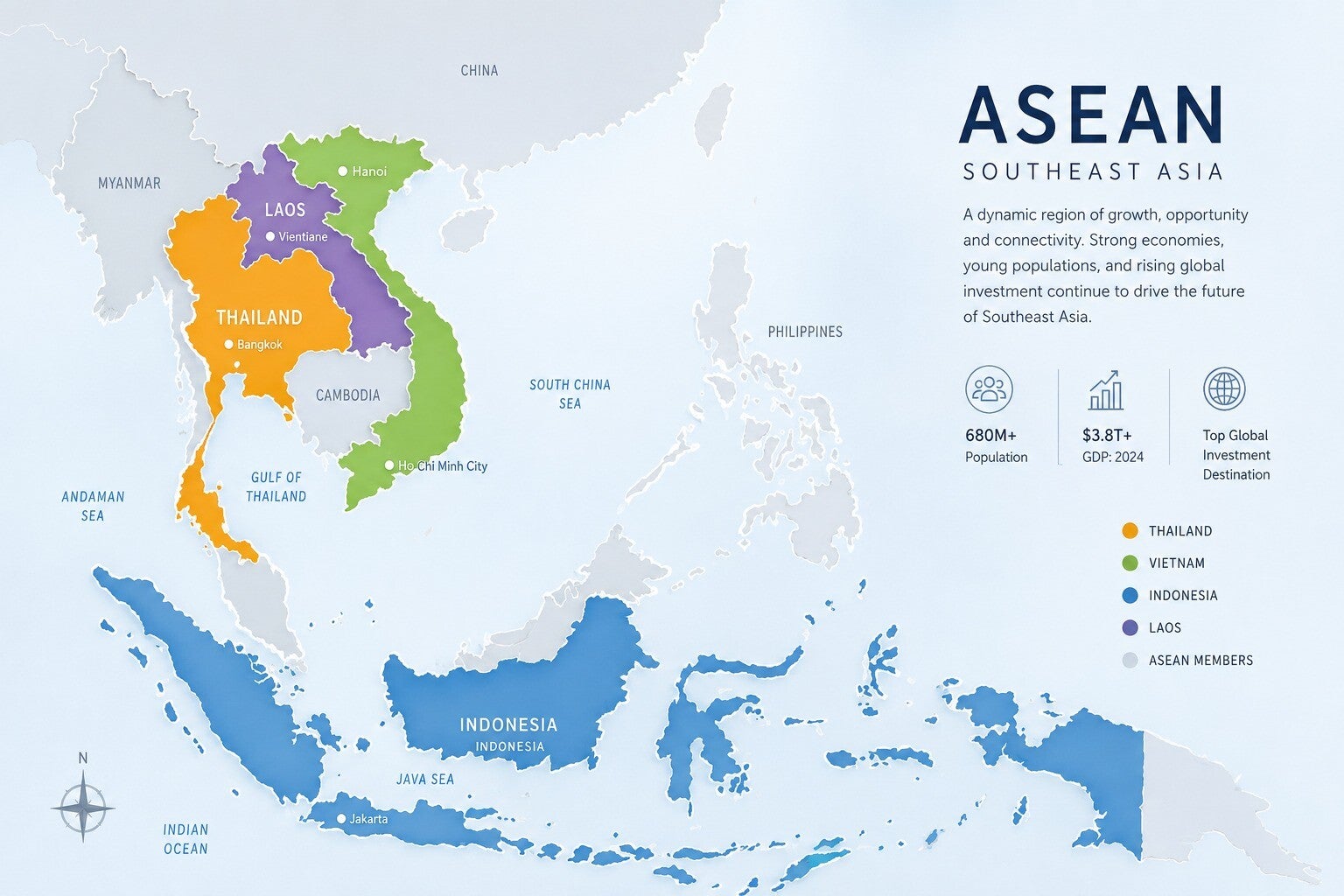
Southeast Asia: A Region of Growth
Southeast Asia continues to attract global investors through a combination of economic expansion, urbanization, infrastructure development, rising consumer demand and strong tourism fundamentals.
The region's real estate markets are supported by several long-term growth drivers:
- Growing middle-class populations
- Increasing international tourism
- Expanding infrastructure and connectivity
- Rising demand for hotels and resorts
- Urban development and residential demand
- Growing foreign direct investment
- Attractive opportunities in emerging markets
The region also benefits from increasing connectivity between major cities and tourism destinations, creating new opportunities for real estate development and hospitality investment.
Investment Outlook
As Southeast Asia continues to develop, real estate is becoming increasingly connected to tourism, infrastructure and broader economic growth.
For investors, this creates opportunities across hospitality assets, resort developments, mixed-use projects, commercial real estate and strategically located development land.
While each ASEAN market has its own economic conditions and investment profile, the combination of tourism growth, infrastructure investment and rising demand for high-quality real estate provides a strong foundation for long-term opportunities
INDONESIA
Scale, Tourism and Emerging Destinations
Indonesia offers one of the most diverse real estate investment environments in Southeast Asia.
The country's large domestic economy, extensive coastline, globally recognized tourism destinations and continuing infrastructure development create opportunities ranging from established luxury hospitality to emerging destination development.
The World Bank projects Indonesia's economy to grow approximately 4.7% in 2026, followed by around 5.2% growth in 2027 and 2028.
Tourism & Hospitality Outlook
Indonesia's international tourism market continues to expand.
In April 2026, the country recorded approximately 1.25 million international visitor arrivals, representing a 7.22% year-on-year increase.
Star-hotel occupancy reached approximately 48.83% during the same month.
Indonesia's hospitality opportunity extends beyond established destinations such as Bali. Emerging areas are attracting increasing attention as infrastructure improves and international tourism expands.
Key Investment Destinations
Bali — Established global luxury and lifestyle destination
Jakarta — Business, commercial and mixed-use real estate
Lombok — Emerging tourism and resort destination
South Lombok — Development opportunities supported by growing tourism and infrastructure
Indonesia presents opportunities in:
- Luxury resorts
- Boutique hotels
- Villa developments
- Eco-resorts
- Wellness retreats
- Resort development land
- Hospitality acquisitions
The country's combination of scale, tourism strength and emerging destinations provides opportunities for investors seeking both established hospitality markets and earlier-stage development opportunities.
VIETNAM
Strong Economic Growth and Expanding Tourism
Vietnam has emerged as one of Southeast Asia's most dynamic real estate and hospitality markets.
The country combines strong economic growth with urbanization, infrastructure investment, expanding consumer demand and rapidly developing tourism destinations.
The World Bank projects Vietnam's economy to grow approximately 6.8% in 2026, followed by 7.1% in 2027.
These growth expectations position Vietnam among the region's strongest economies for long-term investment.
Tourism & Hospitality Outlook
Vietnam's tourism sector continues to show strong momentum.
The country welcomed approximately 12.25 million international visitors during the first six months of 2026, representing a 14.9% increase year-on-year.
Vietnam is targeting approximately 25 million international visitors in 2026, highlighting the country's continued focus on tourism expansion.
The combination of rising tourism demand and expanding infrastructure is supporting opportunities across coastal and urban hospitality markets.
Key Investment Destinations
Ho Chi Minh City — Commercial, residential and mixed-use development
Hanoi — Business, commercial and urban development
Da Nang — Coastal tourism and resort development
Phu Quoc — Luxury resorts and destination hospitality
Central Vietnam — Beach, cultural and lifestyle tourism
Potential investment opportunities include:
- Beach resorts
- Luxury hotels
- Boutique hospitality
- Wellness resorts
- Resort development land
- Hotel acquisitions
- Branded hospitality
Vietnam's combination of strong economic growth, accelerating tourism and infrastructure development provides a compelling long-term outlook for real estate and hospitality investors.
THAILAND
An Established Market with a Shift Toward Higher-Value Tourism
Thailand remains one of Southeast Asia's most established real estate and hospitality markets. Its mature tourism infrastructure, international connectivity and globally recognized destinations continue to support demand for hotels, resorts, branded residences and lifestyle developments.
The World Bank projects Thailand's economy to grow approximately 1.7% in 2026, with growth expected to strengthen to around 2.1% in 2027.
While Thailand's economic growth is more moderate than some neighboring markets, its established tourism ecosystem remains a major advantage for hospitality investors.
Tourism & Hospitality Outlook
Thailand welcomed more than 14 million international visitors by June 2, 2026, generating approximately THB 679 billion in tourism revenue.
The Tourism Authority of Thailand is targeting approximately 33 million international arrivals and around THB 2.65 trillion in total tourism revenue for 2026.
Thailand's tourism strategy is increasingly focused on quality over volume, with greater emphasis on luxury travel, wellness, culture, gastronomy and unique experiences.
This creates opportunities for investors in:
- Luxury resorts
- Boutique hotels
- Branded residences
- Wellness resorts
- Hotel acquisitions
- Mixed-use hospitality developments
Key Investment Destinations
Bangkok — Commercial, business and mixed-use development
Phuket — Luxury resorts, branded residences and international tourism
Pattaya — Hospitality, residential and lifestyle development
Chiang Mai — Wellness, lifestyle and cultural tourism
Thailand's future hospitality opportunity is increasingly centered on attracting higher-spending travelers through premium experiences and differentiated properties.
LAOS
An Emerging Market with Growing Regional Connectivity
Laos is a smaller and more emerging real estate market compared with Thailand, Vietnam and Indonesia. However, its strategic position within mainland Southeast Asia and improving regional connectivity create a distinct long-term investment proposition.
The World Bank projects Laos' economy to grow approximately 3.8% in 2026, with moderate growth expected to continue over the following years.
Infrastructure development and stronger regional connections are important factors supporting the country's future economic and tourism potential.
Tourism & Hospitality Outlook
Tourism remains an important part of the Lao economy.
Laos recorded approximately 4.6 million international arrivals in 2025, up from more than 4.1 million in 2024.
For 2026, the country expects approximately 5–6 million international tourists, with Chinese visitors expected to represent a significant share of arrivals.
Improving regional connectivity, including the Lao-China railway, is helping integrate Laos more closely with neighboring markets and regional tourism routes.
Key Investment Destinations
Vientiane — Commercial and urban development
Luang Prabang — Cultural tourism and boutique hospitality
Mekong destinations — Nature, lifestyle and experiential tourism
Regional corridors — Infrastructure-led commercial opportunities
Laos is particularly suited to selective and niche hospitality investment, including:
- Boutique hotels
- Eco-resorts
- Cultural tourism
- Wellness retreats
- Nature-based hospitality
- Small luxury resorts
As regional connectivity improves, Laos offers the potential to participate in an emerging tourism market before it reaches the maturity of neighboring destinations.
Market Rating Investment Profile
Indonesia ⭐⭐⭐⭐⭐
Scale & Tourism — Large market with established and emerging destinations
Vietnam ⭐⭐⭐⭐⭐
High Growth — Strong economic expansion, tourism growth and infrastructure
Thailand ⭐⭐⭐⭐
Mature & Premium — Established hospitality with strong luxury positioning
Laos ⭐⭐⭐½
Emerging & Selective — Earlier-stage market with higher risk and potential upside
Investing in Southeast Asia's next Generation of Hospitality
Southeast Asia offers a diverse range of real estate and hospitality opportunities — from established luxury resorts to emerging destinations with significant development potential.
For investors seeking hotel acquisitions, resort investments, development land or strategic hospitality opportunities, understanding the differences between each market is essential.
Realty Asia provides access to selected real estate and hospitality opportunities across Southeast Asia, connecting investors with assets positioned for long-term growth.
Sources & Data: World Bank, CBRE Research, ASEAN, and relevant national tourism and statistical authorities